28 May 2008
From Keith Gessen's "Money" in n+1

19 May 2008
Another quote on labor law --
15 May 2008
13 May 2008
A quote from Karl Klare about Labor
28 April 2008
What I never understood about money ...
Two things are weird about this to me. Firstly, the actual fish didn't change. It arguably lost value by the time of the third sale since it was probably rotting. But the price paid for it increased so much. No extra work had been put into the fish, but within three transactions and not more than 48 hours, the price of the fish rose by nearly a million dollars.
The second thing that's weird is that the people who initially sold it for $20,000 thought they had hit the jackpot, but when they later learned that the fish sold for HK$1 million, they realized they lost money. Yet, here again, nothing changed about their initial situation (their sale of the fish for $20,000). They still had the money. They had expended no more effort. So how were they the losers in this situation? But even my stomach churns for them! They were cheated!
Even though I know that this is a common and normal situation, I still find it difficult to understand how something is valued. How do we arrive at a consensus on what something is worth? And isn't it strange that people are able to profit off the process of reaching that consensus?
19 April 2008
The roots of revolutions, a quote via Cheryl
"Whether conditions in China had deteriorated to the extent to which a revolution was inevitable is perhaps besides the point, although this issue animates an impressive body of Western as well as Chinese scholarship. It takes more than oppression and misery to make a revolution... There is no threshold of human endurance beyond which human beings automatically become revolutionary. A revolution is the product of the human ability to reflect on one's conditions of existence and to work those reflections through a system of ideas that provides a vision of a more hopeful future, a social vision that exists at the level of the imaginary in that it conceives of something that does not yet exist" (Ann Anagnost, 34)
16 April 2008
From my notes, extreme frustration, March 16, 2006
11 April 2008
The Important Numbers to Know
"According to the 1991 census, the scheduled castes constituted about 16.5% of India's population, and the Scheduled Tribes 8.1%....The Mandal Commission, the only nationwide source available on the OBC's, suggests that Hindu OBC's constitute about 43.7% of the total population."
03 April 2008
Something to remember: Madras schools
01 April 2008
More on Obama
“The problem with talking about hope all the time is that these are not hopeful lands; Obama is talking change to people who equate change with life getting worse,” said Hank Sheinkopf, a Democratic Party consultant who has studied the political culture of these working-class states with a Talmudic intensity.
...“If you’re an unemployed steelworker, a former coal miner, you want to know about job training, who pays your health care,” Dr. Madonna said. “Obama’s speeches are uplifting but without much specificity, and that’s a tough sell for working people who don’t live in a world of ideas.”
28 March 2008
The best thing I've read on the election
"All in all, the candidates’ positions on the mortgage crisis tell the same tale as their positions on health care: a tale that is seriously at odds with the way they’re often portrayed.
Mr. McCain, we’re told, is a straight-talking maverick. But on domestic policy, he offers neither straight talk nor originality; instead, he panders shamelessly to right-wing ideologues.
Mrs. Clinton, we’re assured by sources right and left, tortures puppies and eats babies. But her policy proposals continue to be surprisingly bold and progressive.
Finally, Mr. Obama is widely portrayed, not least by himself, as a transformational figure who will usher in a new era. But his actual policy proposals, though liberal, tend to be cautious and relatively orthodox.
Do these policy comparisons really tell us what each candidate would be like as president? Not necessarily — but they’re the best guide we have."
19 March 2008
The choice: A good life or doing good in life?
"'It is an unfortunate circumstance that you can spend an hour with a patient treating them for diabetes and hypertension and make $100, or you can do Botox and make $2,000 in the same time,' said Dr. Eric C. Parlette, 35, a dermatologist in Chestnut Hill, Mass., who chose his field because he wanted to perform procedures, like skin-cancer surgery and cosmetic treatments, while keeping regular hours and earning a rewarding salary."
16 March 2008
The American Way
"Every society is threatened by a nearly infinite number of dangers, Glassner writes, but societies differ in what they choose to fear. Americans, interestingly, tend to be most preoccupied with those dangers that are among the least likely to cause us harm, while we ignore the problems that are hurting the greatest number of people. We suffer from a national confusion between true threats and imagined threats. And our imagined threats, Glassner argues, very often serve to mask true threats.
Quite a bit of noise, for example, is made about the minuscule risk that our children might be molested by strange pedophiles, while in reality most children who are sexually molested are molested by close relatives in their own homes. The greatest risk factor for these children is not the proximity of a pedophile or a pervert but the poverty in which they tend to live.
...
The word pioneer betrays a disturbing willingness to repeat the worst mistake of the pioneers of the American West—the mistake of considering an inhabited place uninhabited. To imagine oneself as a pioneer in a place as densely populated as Chicago is either to deny the existence of your neighbors or to cast them as natives who must be displaced. Either way, it is a hostile fantasy."
12 March 2008
Taxation?
11 March 2008
Microlending and the Cult of the Entrepreneur
09 March 2008
One last one from Hobsbawm
"We should not forget that, whatever yardstick is used, the majority of peoples are better off at the end of the twentieth century, in spite of the extraordinary catastrophes that have marked it....Overall, we have today three times the population there was at the start of the twentieth century, and all these people are physically stronger, taller, longer living and healthier. They suffer less hunger and famine, enjoy a higher income, and have an immeasurably greater access to goods and services, including those which guarantee greater opportunities in life, such as education.... This is also true of poorer countries. After all, there has not been a famine in India since 1943."
08 March 2008
From Amita Baviskar's speech at MIDS, 2005
Malcolm Adiseshiah Award Ceremony Speech
From David Mosse's "Tank Irrigation in South India"
"The legitimate need to generalize 'design principles' for farmer-controlled irrigation here, no less than the colonial administration's use of 'custom' involves an institutional isolation of resource management from its particular historical and social context, and, in doing so overlooks the importance of political relations and the 'cultural' construction of natural resources." (304)
"The extension of state power which lay behind the regimentation of 'local knowledge' and invention of tradition was hardly disguised." (312)
04 March 2008
From my summer notes (from Phil)
"There was so much that was real that was not real at all.
He wanted to feel the same way over and over."
From Eric Hobsbawm
"The greatest cruelties of our century have been the impersonal cruelties of removed decision, of system and routine, especially when they could be justified as regrettable operational necessities."
From The Age of Extremes
"During the short twentieth century, more human beings had been killed or allowed to die by human decision than ever before in history." (12)
"It is not easy to grasp the extent of the, unfortunately accelerating, return to what our nineteenth century ancestors would have called the standards of barbarism... We forget that an international convention once provided that hostilities in war 'must not commence without previous and explicit warning in the form of a reasoned declaration of war or of an ultimatum with conditional declaration of war,' for when was the last war that began with such an explicit or implicit declaration?" (13)
He quotes the following from Rules as to Bombardment by Aircraft, 1921
"It may be thought better, in view of the allegations of "barbarity" of air attacks, to preserve appearances by formulating milder rules and by still nominally confining bombardment to targets which are strictly military in character....to avoid emphasizing the truth that air warfare has made such restrictions obsolete and impossible. It may be some time until another war occurs and meanwhile the public may become educated as to the meaning of air power." (21)
From The Age of Capital
1848 "marked the end, at least in Europe, of the politics of tradition, of the monarchies which believed that their peoples accepted, even welcomed, the rule of divinely appointed dynasties presiding over hierarchically stratified societies.... Henceforth, the forces of conservatism, privilege and wealth would have to defend themselves in new ways." (39)
The unprecedented economic boom after the revolutions of 1848 "gave the governments shaken by the revolution invaluable breathing space and conversely wrecked the hopes of the revolutionaries." (45) Between 1800 and 1840, world trade did not even double. Between 1850 and 1870, there was a 260% increase. There were two, maybe three, preconditions to this massive increase in trade -- the railroad, the telegraph, and to a lesser extent the gold rushes which provided the capital.
03 March 2008
From Sam Bass-Warner's "The Private City," 1968
02 March 2008
Two quotes I recently read on food
"The World Food Program, the United Nations agency responsible for feeding three million people affected by the conflict in Darfur, in western Sudan, announced Friday that it would cut in half the amount of food it distributed there because it was short of money.
The food program said it had received just a third of the $746 million it had requested from donor nations for all of its operations in Sudan. As a result, individual rations that include grain, blended foods, beans, oil, sugar and salt for people in Darfur, where a brutal ethnic and political conflict has raged since 2003, will be reduced from 2,100 calories a day to 1,050 calories — about half the level the agency recommends.
In March, the agency announced an initial cut of sugar, salt and beans to some Darfur residents, but that reduction did not include grain, blended foods or oil, the rations' main sources of calories."
Describing the events during the joint annual meeting of the Boards of Governors of the World Bank and the International Monetary Fund attended by 10,000 people.
"The total cost of the 700 social events laid on for delegates during that single week was estimated at $10 million..... Ridgewells, a well known Washington catering company, prepared twenty nine parties in one day alone, according to executive Jeff Ellis who added: 'This year the hosts want more expensive menus, and they're inviting 30 per cent more people. No one is stinting -- but, then, they never have." A single formal dinner catered by Ridgewells cost $200 per person. Guests began with crab cakes, caviare and creme fraiche, smoked salmon and mini beef Wellingtons. The fish course was lobster with corn rounds followed by citrus sorbet. The entree was duck with lime sauce, served with artichoke bottoms filled with baby carrots. A hearts of palm salad was also offered accompanied by sage cheese souffles with a port wine dressing. Dessert was a German chocolate turnip sauced with raspberry coulis, ice-cream bonbons and flaming coffee royale." (38)
Quote from the Draft Rural Employment Guarantee Act, 2004
Among the entitlements of labourers according to the 2004 draft of the Act is the following:
"(2) The following facilities shall be available at the worksites: (1) safe drinking water; (ii) shade for small children and periods of rest; (iii) a first-aid box with adequate material for emergency treatment of minor injuries, strokes, body aches and other health hazards connected with the work being performed."
Water and shade? It is astounding to me how minimal these entitlements are.
23 June 2007
DELHI DEEDS
Even the elites among us must suffer gross injustice at the hands of the Municipal Corporation of Delhi. According to this article, the top brass of the MCD have been desperately vying for membership at the India Habitat Center, one of the most exclusive clubs in the Capital. However, old MCD officials who refuse to give up their membership cards are standing in their way. But never fear: the article assures us that one new MCD official “is understood to have sent several letters… to make him a member at the earliest.” Good to see the MCD assiduously battling injustice in every corner of the city!
Meanwhile, the city’s poorest are caught in the battle between the two behemoth bureaucracies that run Delhi, the MCD and the Delhi Development Authority. The banks of the Yamuna River (called the Yamuna Pushta) in the center of Delhi were cleared of its 150,000 odd residents by the DDA in early 2004 to make way for a large park and tourist destination. Since the massive evictions, keeping this area clear has been causing nothing but headaches for the DDA. Firstly, former residents, many of whom had lived on the Yamuna banks for decades, kept returning to the rubble of their old homes. The DDA was finally forced to call in the Home Guard to keep these “encroachers” off the land.
Now, even the MCD seems out to ruin the DDA’s plans. On January 5, the MCD announced that 1,167 vendors who were kicked out of the kabari bazaar behind Red Fort after an attack on the Fort in 2000 would be given vacant land in the Yamuna Pushta to reopen their stalls. After significant opposition from DDA officials who feared that this would lead to slums being put up in the Pushta again, the MCD cancelled the allotment. The DDA was apparently prepared to fight. According to this article, the DDA hired private guards and warned the Delhi police that there might be violence if the MCD continued with their plan. Sadly, the vendors had already been given their allotments, and many of them came in the morning to set up their wares. They were blocked from the area by police and para-military personnel.
If only the DDA would pause to think for a moment about the reasons why people would continually try to return to an area covered in rubble to live under plastic sheets. It is because the location is central to their livelihoods—as rickshaw pullers, street vendors, domestic servants, etc—and their livelihoods are central to the way in which we all live our lives in Delhi.
MEDIA WATCH
On October 9th, 2004, a small but very strange article appeared in the Chennai edition of The Hindu. This article reported that the current Tamil Nadu Chief Minister J. Jayalalithaa had been awarded the “Golden Star of Honor and Dignity Award” by the International Human Rights Defence Committee (IHRDC), a Ukrainian human rights organization. The article was based on a press release from the AIDMK party, which Jayalalithaa heads. The press release was also picked up by a couple of news wires, and the story appeared in Indiadaily.com, The Hindustan Times, and The Economic Times among others.
On October 12th, supporters of Jayalalithaa, known as the “Puratchi Thalaivi” or Revolutionary Leader, took out full page ads in the back of The Hindu congratulating her for receiving the award. The advertisement noted that the presentation ceremony, oddly enough, was not held in the Ukraine, but in Chennai on October 11th. The press release also stated that past winners of the award include Kofi Annan, as well as the increasingly authoritarian Vladimir Putin.
No news in English is available on the activities of the Ukrainian organization on the internet outside of their own website, which is also silent on specifics about their activities outside of awarding human rights awards. Although the press release from the AIDMK states that the IHRDC is a consultative body to the UN, no available UN documents mention their name.
The award was conferred upon Jayalalithaa by Alfred Kitcher, the director of the IHRDC, who is also the head of the World Transformation Church currently operating in the Ukraine. The aims of the World Transformation Church, according to their own website, are “to serve in an apostolic and prophetic capacity to nations (governments) and peoples by bringing forth relevant ministry in the fields of national reconstruction and development, economic growth, prosperity and self reliance.”
That the newspapers failed to remark on the fact that the Chief Minister of Tamil Nadu received a highly publicized human rights award from a dubious Ukrainian organization headed by a man whose apparent aim is to merge Church and State in the Ukraine is strange. What is stranger is that the newspapers failed to mention in a single one of these articles that the Puratchi Thalaivi’s record on human rights is abysmal.
She has thrown numerous political opponents in jail under the Prevention of Terrorism Act (POTA), most famously Vaiko, the MDMK leader who languished for 577 days in a cell in Vellore. Under her watch, inter-caste violence in Tamil Nadu has seen a sharp increase; it is said that her party instigates such caste rivalries. When teachers and government employees dared to strike in 2003 protesting a cut in their pensions, she fired 200,000 of them, effectively paralyzing their right to strike. Her party is also widely acknowledged to be highly corrupt, a fair indication of the fact that the Jayalalithaa government’s priorities are not with the people.
Why, then, did an article reporting that Jayalalithaa was given an award for her commitment to human rights appear without comment in so many Indian newspapers? That it ran in The Hindu is particularly surprising; it was less than a year ago that the notoriously willful Chief Minister had attempted to have The Hindu’s senior editorial staff thrown in jail because they had described her speeches in the state legislative assembly as “stinging abuse” and “unrestrained attacks on the Opposition.”
The news media, without exception, failed to question any of the claims made in the AIDMK press release. It is such uncritical reporting that increases the legitimacy of political leaders who fail to observe the most basic limits on their power, and allows them to stay in power at great cost to the Indian people.
26 April 2006
Post Script
According to a friend of mine who works closely with the fishermen in the city, the kuppam in Triplicane has an interesting story about their relationship with the
This makes sense. Even the
18 April 2006
The heat and the temple festivals
The heat has settled like a woolen blanket over the city, and people are adjusting as best they can. Vendors line up wedges of watermelon under glass covers to keep out the flies. These and tender coconut water sell quickly. An institution trying to do a good deed in
It is also a time of temple festivals in
A few nights before that, I had gone out to dinner with a friend of mine. We were talking very late, till midnight, so he walked me home. As we turned into the area in front of the temple tank in Tiruvanmiyur, we saw a crowd under the large maidan where a band was playing. In the middle of the crowd was an enormous palanquin, on which was placed the decorated idol of Shiva, carried by a large group of young men. The idol was held facing the door of the temple. Two red flags flanked the palanquin with the sun and moon on them (Surya and Chandra), as well as two lamps. To our delight (we are both serious Bharata Natyam dancers), the idol danced! The palanquin bearers rocked the deity from side to side, while running back and forth on the maidan, the idol making a graceful zig zag. The lamps were moved up and down with the rocking and the flags were spun, horns were blown and drums were beaten, showing how the universe itself spun when Shiva danced.
More than the idol, I was mesmerized by the palanquin bearers who were intensely concentrated on their movements, at the degree of coordination needed in a group of that size in order to make the deity perform its intricate dance. Eight young men bearing Ambal’s palanquin ahead of Shiva did a pradakshanam around him, executing a kind of complex two step as they carried her. These men were closer to me, I could see their knitted brows, their profuse sweating, the order and beauty they carved as they progressed through the chaos of the crowds and smoke. These were obviously not priests, and because local people were involved with the rituals of the temple, this festival seemed to be much more concerned with reinforcing bonds of community, a kind of collective adoration of the god rather than the kind of individual awe invoked in bigger temples like the Brihadeeshwara in Tanjavur or in a cathedrals.
History, as I found in my reading, supports this intuition. The nadanam or dancing of the idol has been taking place in Tiruvanmiyur (thought to be at least 1,200 years old) and in a series of other temples in Tamil Nadu for hundreds of years. These boys who hold the palanquin were exercising hereditary rights to participate in temple rituals held by certain of the fishing communities in
One historian of
Unlike most poor communities in the cities, the largest slums of
09 April 2006
A New Leaf Turned


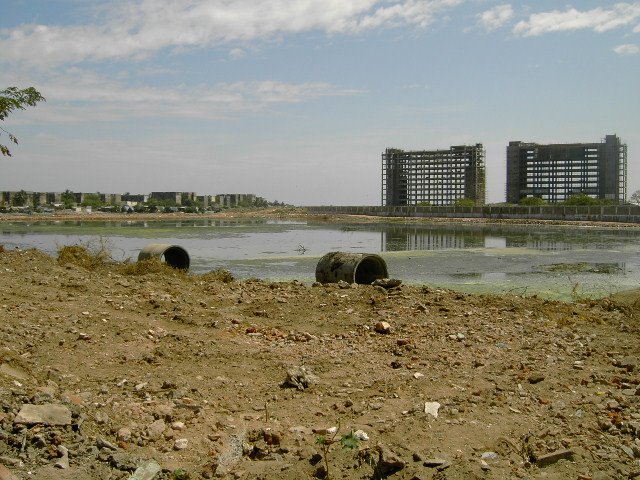
I was later to find out that this visual drama is reflected in recent contentious history. In 2003, the community, along with other citizens’ groups in the city, fought against the Tamil Nadu government who wanted to build a Rs. 500 crore administrative and corporate complex along the beach. The beach, which was envisioned by one of the earliest governors in Madras Elihu Yale to be a “lung” for the city, was saved for the moment by the work of these groups. But the problem of eviction from their valuable beachside lands came up again in a different form a few years later.
On December 26, 2004, Srinivasapuram lost over 50 lives to the tsunami, as well as numerous homes and valuable property. As relief and rehabilitation became the stuff of daily news, Srinivaspuram residents were asked to leave their homes and move to temporary housing in Thoraipakkam, a strip of marshy land well inland. Some residents were intimidated into moving, but most refused and have stayed on in Srinivasapuram. Those who moved found that the temporary housing conditions were awful, tin huts that baked like ovens in the sun in an area that was far from any government services and sources of livelihood. Many have since returned. Residents and many of the groups working in Srinivasapuram felt that the temporary housing Thoraipakkam was part of a larger effort to move those residents of the beach who had the strongest claims to the land, the fishermen, away from their homes.
At their heart, questions of eviction in
I’ve been working regularly on my project, communicating with groups in Srinivasapuram and researching the history of slums, fishermen’s communities, and poverty in
Please check back frequently over the next three months, and please comment on the site. And wish me luck!
08 March 2006
Rain and Relief
1.
Following politics in
Take this recent example. Last month, an article appeared on the Hindu’s front page reporting that Jayalalithaa, AIDMK leader and current Chief Minister of the state, had excoriated the Central government because they had “surreptitiously blocked” her plans to build a desalination plant to provide drinking water for the city. How exactly had they done this? Apparently, A. Raja, the central government’s Minister for Environment and Forests and a member of the opposition DMK party in Tamil Nadu, had “raised all sorts of queries about the project. Jayalalithaa’s tirade against Raja is quoted at length in the article:
“It is amazing how queries relating to the impact of the project on biological entities especially fish and shell fish population in the area, its likely impact on the livelihood of the coastal community, management and disposal method of sludge and solid waste generated, as also the characteristics of the sludge have been raised.”
What is most amazing about Raja’s questions is how reasonable they are, a rare case of an environment minister looking closely at the range of potential damage of a high cost development project. But the article itself says nothing beyond quoting Jayalalithaa. It doesn’t mention, for example, that despite terrible water problems in the city, there has been considerable citizen opposition to the desalination plant, based on concerns similar to Raja’s. Nor does the article mention that cheaper and less energy intensive solutions exist to the water problem, but that these might be less attractive to a politician looking to gain political mileage before the upcoming elections. The article does not even mention that there are upcoming elections. Instead, the article goes on to quote Jayalalithaa again:
“[Raja’s] unscrupulous perfidy against the people of Tamil Nadu tears apart the smokescreen of pretence and deceit of bringing projects and programmes for the people of Tamil Nadu practiced by the DPA, which has 12 Ministers in the Union Cabinet.”
Never mind that this sentence is barely sensible; that’s its point. Any attempt at debate over Jayalalithaa’s policy measures will be immediately squelched by her paranoid and fanatical cries of partisanship. And still, the newspaper says nothing.
I used to think that this kind of reporting was a peculiarly Indian journalistic style or, more unfairly, the product of sheer ineptitude. But I’m beginning to think that such deadpan reporting is the product of extreme cynicism about the government by citizens, unsurprising in a country where a recent bill to prevent convicted criminals from running for office was the subject of heated debate. At the same time, I understand why many reporters shy away from context or narratives in
2.
In October of 2005, one of the most severe monsoons in Tamil Nadu in the past 25 years began. Some 200 centimeters of rain fell over three months[1], most of it in five two to three day bouts, causing extensive flooding in 22 districts in the state. In the city of
The morning after the first and most severe bout of rains, the newspapers printed Jayalalithaa’s assurances that her government was dealing with the situation on a “war footing.” In practice, it was unclear exactly what this meant for the government. One reporter I spoke with suggested that war footing meant a blanket sanction for ad hoc measures to deal with the rain. While major emergencies were handled well by the government, with one of the world’s largest standing armies helping in many areas of Tamil Nadu to evacuate thousands of people, manage emergency shelters, and prevent extensive flooding of riverside cities, much of the less dramatic aspects of disaster management was handled by citizens. In parts of
The morning after a severe period of rains in early December, I was returning to Chennai from
3.
While in rural areas, numerous people drowned, the rains themselves did not cause many deaths in the city beyond a handful of electrocutions. Ironically, what caused deaths – nearly 50 people dead and many more severely injured – were stampedes at centers set up to distribute relief materials to those affected by the floods. Jayalalithaa, mindful that this was an election year, determined that each household affected by the rains should receive 10 kilograms of rice, a liter of kerosene, a sari, a dhoti, and two thousand rupees cash, a huge amount by any standards. Affected streets were chosen by officials from the Collector’s office, and anyone on these streets with a ration card, regardless of whether they lived in thatched huts or cement houses, was eligible for relief materials.
The initial round of relief distribution caused a maelstrom of activity. Opposition politicians, unable to sit quietly as the AIDMK gave large and legal cash handouts to voters, loudly complained that relief distribution was inadequate and directed towards AIDMK strongholds, and demanded Jayalalithaa’s resignation. Citizens protested all over the city, blocking traffic on main roads and mobbing the houses of municipal officers, demanding that more areas be given relief. It being an election year, the government responded. All in all, three lists were drawn up of affected areas, ensuring that nearly everybody with a ration card in the city was eligible for relief.
Early on a Sunday morning in Vyasarpadi on November 6th, six people died in a stampede at a government school while waiting to collect relief materials. A little over a month later on December 18th, in MGR Nagar, a shocking 42 people died in another stampede at a government school at 4:00 am. An article in Frontline described the events:
“The victims, 23 of them women, were part of a large group of people who had patiently waited on a slushy road all through the night, braving intermittent rain, to collect tokens for receiving state assistance… The two tragedies had some strikingly similar features. Both occurred on Sundays, in the early hours of the day, and after large numbers of people waited in despair for long hours under inadequate protection.”
Nearly 9,000 families were eligible to collect their supplies from this relief center. On the first day, 3,452 families came. That means that approximately 5,000 families were still due to collect relief the next day. Relief seekers gathered from Saturday night to be first in line for Sunday’s relief distribution. Yet the police only posted three men at the center during the night, even as crowds swelled to 4,000 people in the early hours of the morning. Some news reports mentioned that a police truck drove into the area, leading relief seekers to believe that token distribution had begun and they began pushing forward causing a stampede.[2] Others blamed a sudden downpour.[3]
News about the stampede quickly descended into dreary politicking. Jayalalithaa announced compensation of a lakh rupees to families of the dead, and 15,000 to each of the injured. Opposition parties again called for her immediate resignation. Jayalalithaa managed to reduce even a stampede at a relief center into partisan misbehavior, publicly blaming the deaths on “rumors” about Sunday being the last day for relief distribution spread by “some culprits and miscreants…who want to bring a bad name to the government.” Within three days she had arrested her miscreant, predictably, a DMK member and a ward councilor from the area, Dhanasekaran.
A newspaper article that described Dhanasekaran’s arrest mentioned that he was a heart patient and required medicines and regular treatment, but did not mention that had there been adequate police protection, not even the most outrageous rumors could have caused a stampede. The government also decided that since Sundays seemed to cause a problem for relief distribution, they would do away with distribution on Sundays,[4] thereby forcing families who needed the money because they missed work on rainy days to miss another day of work to collect it. The Supreme Court later dismissed the claims made by the Chief Minister about “miscreants,” saying succinctly that “[r]umor means there is no source… the incident took place because the officers were not making preparations for providing flood relief.” Dhanasekaran and his friends were released, and the press has since forgotten about the incidents.
4.
Photographs from the MGR Nagar stampede were horrific, women and children wailing, and the bodies of the dead with their faces bloated and purple. Unlike dreary newspaper reporting about the incident, which seemed to take the occurrence of the stampede almost for granted, the question of how the stampede could have occurred refused to be so easily dismissed by the photographs.
I knew little about the procedures for relief seekers, so I met Mr. Rajendra Babu, Corporation Chairman of Zone 10 at his Adyar office. He was surrounded by a group of men, none of whom seemed to have any pressing business with him. They moved aside when I came forward, but stayed and listened to our conversation and murmured their assents whenever Mr. Babu spoke, and sometimes answered one of Mr. Babu’s three cell phones when they rang.
Mr. Babu assured me that procedures for collecting flood relief were very straightforward. Street by street identifications of affected areas by revenue officers and officials from the Collectors’ office meant there were fewer chances of people complaining about partisan favoritism. Relief was given out in such large amounts because each time it rained, people could not go to work and they had lost their earnings repeatedly during these months. “Whoever got left out from the first round of relief, we put on the second list. And then we made a third list of streets.” Announcements were made in every area clarifying when and where and for whom flood relief distribution would take place. When I asked him about the level of damage to houses that would help classify an area as affected, he looked around the room and laughed. “One house fell in Arunachalam Nagar. That’s it. I saw it myself. Only encroachers suffered,” he said, referring to the numerous thatched huts in the city without land deeds, often built precariously on the banks of canals and waterways, “only the encroachers really suffered.”
Yet, while both newspaper accounts and official statements seemed to corroborate Mr. Babu’s words, flood relief procedures seemed to be opaque to many citizens, dependent, as so many things are in bureaucratic
In my neighborhood, Tiruvanmiyur, women sat on the main
On both sides of the
Next to me, a gray haired woman, her cotton sari and white blouse wet and her hair bedraggled, debated loudly with nobody in particular whether or not to go to Gandhi Mandapam where many of the Kotturpuram residents were being housed and fed or to stay on here. “They tell us to stay in our houses or go to Gandhi Mandapam. Then they go and give saris to people who are waiting here in the crowd, so what’s the use of listening to them?” A man nodded in agreement and turned away. As if to reward her for her vigilance, a jeep filled with Sunfeast biscuit boxes pulled up to the curb. The woman hurried into the crowd closing around the jeep until the police drove them away. She waited there, and by reaching her had into a slit in the jeep’s cover, managed to make off with a large box of biscuits.
5.
I visited MGR Nagar about a month after the stampede on a hot day in the middle of the afternoon. The main road there is wide, and freshly laid tar smelled strongly in the heat. Although the thatched huts near the
I was nervous approaching the school; my whole vague project suddenly felt obscene and irreverent. I dawdled as much as I could, looking at my cell phone and making several calls to myself as if phoning for a delayed friend. Finally, I mustered up the courage to walk down the street alone to the gates of the school. The school where the stampede had occurred was located down the end of a long and narrow road off the main road. In the mid-afternoon glare with the heat reverberating off the asphalt, it seemed to my overactive imagination that death marked the road. A young man was unloading stacked cages of quiet chickens from a small lorry into a butcher’s shop. Scales and discarded fish parts from a fish vendor glimmered in the afternoon sun, and clouds of flies rose from ominous stains on the asphalt marking my arrival.
But the school itself seemed unmarked by the gruesome events. The gates were thrown open, and the slight incline up to the gate which had caused relief-seekers to fall and be trampled looked harmless. The only unusually eerie thing about the school was that even in this heat, all the doors and windows facing the courtyard were closed, so that although you could hear their squeals and chatter, you could not see the face of a single child.
Across from the school there were a couple of small shops made of plywood. In the biggest a man and a woman were sitting, manning a small fridge of sodas and packets of water, a phone, large plastic jars of biscuits and toffees—the needs of the children who attended the Arignar Anna Corporation school. This man was Muthukumar, proprietor of Thangalakshmi Stores. Muthukumar indicated behind him when I asked him where his house was.
“Everybody knew that there was money being given out,” he told me, “Everyone also knew the procedures.” He pointed to two poles on either side of the gate at the school, where policemen had strung up megaphones and made announcements for two days beforehand telling people the procedures for collecting relief. At 7:30 in the morning, relief seekers were to be given tokens, and by 9:00 they would start distributing relief. Relief seekers from three different ration shops were to be given relief at this center. They were divided by their ration shop number into three streets where they were supposed to wait for token distribution. First, each person was given a single token which he would then exchange for four tokens inside the school. These four tokens were used to collect the four kinds of relief supplies, a sari and dhoti, rice, kerosene and the money. “Everybody came and collected money,” he said. “Even engineers making 25,000 a month came and collected relief. Look at my house, we don’t need money because it rained. We had no problems. It’s those people who live in the huts near the river who need the money.”
By late evening on Saturday night, a crowd of 300 had already gathered for the next day’s relief distribution. The next day was Sunday, which meant that most people did not have work. “So they were all enjoying themselves,” said Mr. Muthukumar. “See, they had given out relief money in thousand rupee notes to prevent corruption. If you gave out relief in 100 rupee notes, the person who was handing it out could take a couple of 100s and you wouldn’t say anything because you still got 800. So they prevented corruption this way. See over there,” he pointed about 200 meters from the school gate to the liquor shop, “He closed by early evening that Saturday. Why? Because he didn’t have enough change—everyone was bringing him 1,000 rupee notes.”
The crowd swelled after 2:00 am, after the late show at the movies ended and men came to join the crowds. The policemen did their rounds and tried to keep order, but the crowd was defiant. Police cannot hit women without significant provocation and women know that. When the policemen told the women waiting in line to move away and return the next morning, the women would taunt them. “I saw a police inspector fall at the feet of a group of women and beg them to leave. Nobody left.”
“Around that time in the morning,” he continued, “it started to rain. Who would give out tokens at 4:00 in the morning? People knew that, they were not pushing to get tokens. It rained very hard, so people wanted to go inside the school and sit there. At that time this gate did not have a lock. You could just push hard on it and it would open. So people starting pushing inside to sit, and then they started falling.”
“There were too many people waiting. Poor people lost 100 rupees everyday that they could not go to work,” he said again, “Instead of giving it to us, in these concrete houses, they should have given more money to the people in the huts.”
6.
So we now have a situation in which flood relief was being given out in excessive amounts and to excessive numbers of people near an election, with no clarity on what actually constituted an affected household. We have four thousand people standing outside a government school from two in the morning, many of whom are drunk, are arriving after the late show at the movies and many of whom refuse to listen to the police. We have a handful of policemen to keep law and order who did not call in reinforcements when the crowds swelled, and Opposition party members who may or may not have panicked citizens by spreading rumors about this being the last day of relief distribution. And we have the rain, a blistering downpour, which refused to stop. So who is to blame for the stampede deaths? None of the above. Or all of the above, which is what makes participating in Indian politics such a dispiriting activity.
And yet … Pushpa, who comes to my apartment once a day to mop the floors, came to me yesterday and sheepishly asked whether she could borrow some money to pay for her daughter’s school fees. Her husband, a day laborer in construction, was not able to get work this month, and they could not pay their daughter’s school fees. There is obviously an immense need for more subsidies to the poor in this city. This is especially needed in the form of increased social security to those millions who work in the informal sector, usually the poorest residents of a city who live in the most precarious housing conditions. Flood relief was a great benefit to many, but ad hoc systems of relief funds cannot be the answer to this pressing problem. Death by stampede at a relief center during an election year could be avoided if a government system had already been in place to provide exactly the kind of social security that these workers lacked. But who has the political will to implement such a system?
[4] Doraisamy, Vani, “Relief won’t be distributed on Sundays, says Government,” The Hindu. 21 Dec 2005.